To Swim Against the Current: Armenia’s 2026 Election
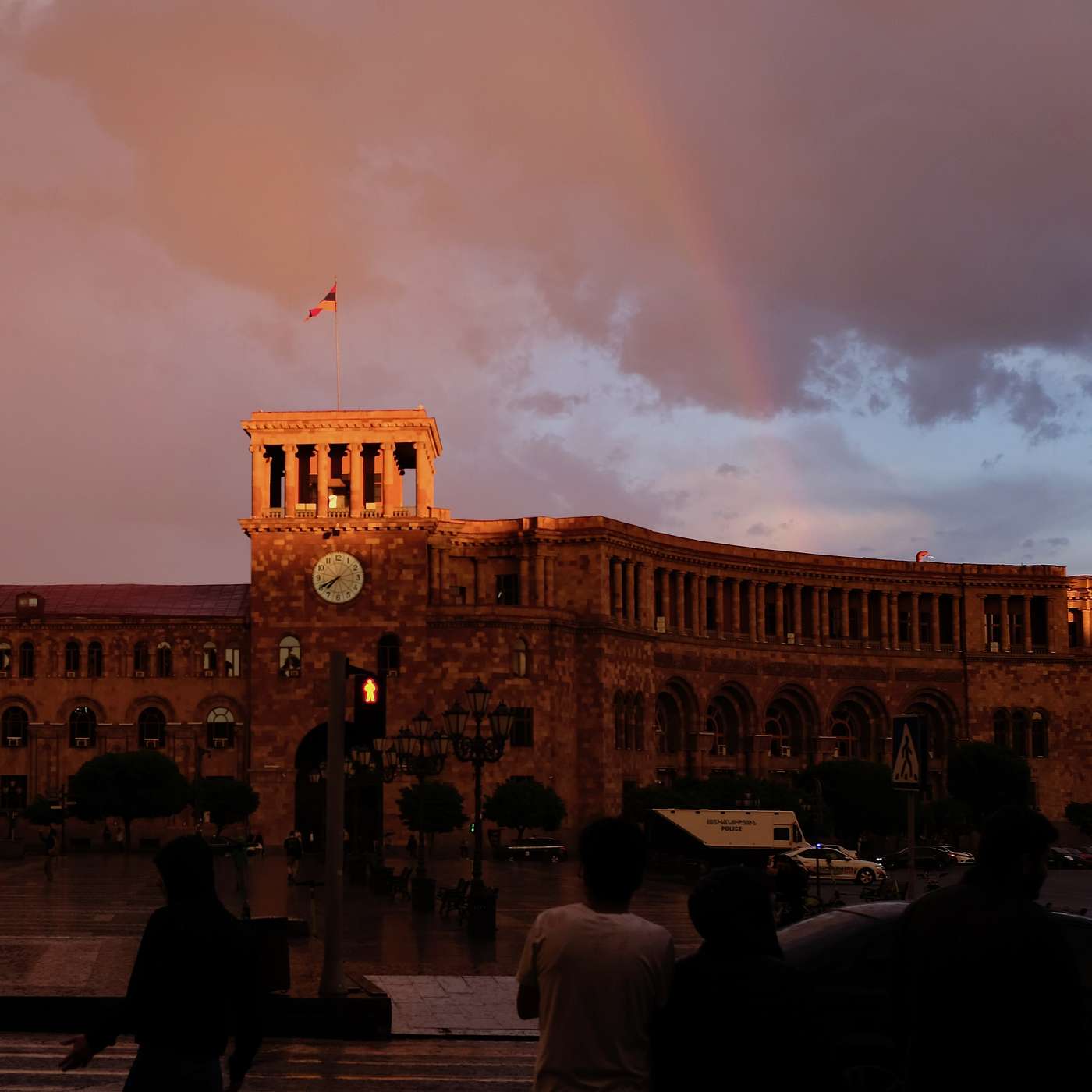
June 7th is Armenia’s parliamentary election. This episode is a temperature check – a snapshot of the mood in 2026. You’ll hear a mosaic of voices from inside Armenia – people sharing their anxieties and hopes for the country as they prepare to head to the polls.
After losing Artsakh, are Armenians ready to normalize relations with Azerbaijan and Turkey? Can we maintain ties with Russia while also aligning ourselves with the EU? Are security and democracy mutually exclusive for Armenia?
Elections are about deciding which politicians should be in power. But they’re also an occasion to think about what is important and what could change. How do Armenians want to shape our future?
This episode made with support from One World Media.
Transcript
Armenian elections aren’t what they used to be.
“Another favorite story of mine comes from local government, again, early '90s, right?”
Yevgenya Paturyan is an Associate Professor and the Program Chair of Politics and Governance at the American University of Armenia.
“So that's when, again, it's a ballot, there is a checkbox, and you have to put any check mark in the box, right? So the particular village's local, government official who has been in power calls his village people in, says, ‘Elections are coming up. I want you to honestly elect whoever you think is a good candidate. I've been your mayor. If you're for me, put a plus next to my name. If you're against me, put a minus next to my name.’ That guy won 100%, right?
“So bribery, intimidation, fraud, not to mention: the lights go off, there's darkness, the lights come back on, there's 20 extra ballots stuffed in. The violence, you know, observers being literally physically pinned to the wall while somebody stuffs the ballots. We've seen it all.”
Armenia is holding parliamentary elections on June 7th. Current Prime Minister NI-kol Pashinyan is up for re-election.
He led the Velvet Revolution against that exact corruption that Professor Paturyan was just talking about. Then he cemented himself as leader of the country in the 2018 elections. He won again, in 2021, in the aftermath of Armenia losing the 2020 Nagorno-Karabagh war. Now - after 8 years in power - he and his party are going back to the voters for a third time.
Before 2018 - many people didn’t feel like their votes counted. What about now?
The main issue is what it has been for a while - what to do about security after the fallout from the 2020 war with Azerbaijan, and losing Artsakh in 2023. Is Pashinyan to blame for the losses? What should be done to ensure Azerbaijan won’t take over more of Armenia’s territory? These are some of the big questions.
We talked with half a dozen people about how they’re feeling. You’ll hear from them one at a time.
For this episode, we’re less interested in the candidates or their platforms. Instead - we wanted to use this election as a chance to talk about how people are feeling about the country: about democracy here, what they’re upset about, and where they think the country could be going. This episode is a temperature check, a snapshot of the mood in 2026.
HRACH
“I was the president of the our class' student council.”
Hrach Arzumanyan has always been into politics, he started in school council when he was in 5th grade.
“I became the vice president of the student council. The year after that, I was the president. The year after that, I was also the president. The year after that, I went to high school, was still the president. On 11th grade, I kind of stopped because I wanted to concentrate more on my studies, so I was advisor to the president. So, you know, they made up a new position for me because the new president didn't know what he was doing, so I had to help this guy.”
Hrach just finished up his undergrad studying Politics and Governance. He grew up in Kapan - in the south of Armenia, near where a lot of the country’s mining goes on. Growing up - he saw the corruption first-hand. The local governor would use his position to get rich, and then - to keep up his support - would pass out money to locals.
“There were cases that people would actually go to him and ask for financial help or whatever, and he would just get his wallet and help. That happened to my dad back in the early 2000s. I was like two years old. My sister needed to have a surgery and, you know, my parents were public school teachers, and back in the day the salary was way worse than it's now.
“So, you know, he just, you know, went to this guy, said, ‘You know what? I have a kid and we need to do a surgery,’ and he just grabbed his wallet, took out like I think it was like 200, $300.
“He could have just made a country where a teacher doesn't need his handouts, right? Pashinyan likes saying it: ‘You're stealing the state budget and then doing, like, philanthropy.’ Like, how does that work? At least on that point, I agree with him.”
So, he agrees with Pashinyan?
“Well, I hate extremes. So whenever somebody says, "Oh, I'm extremely anti-Pashinyan," I hate that. Or pro-Pashinyan, I hate that too. Politically, I'm a centrist. On some points of my life, I was more left, more right, more left. There are a lot of things that I agree with the current government and a lot of things that I agree with the opposition, but I don't think there's a political party in Armenia that aligns with my political beliefs.”
He does understand, though, why Pashinyan has a lot of support from the villages. But - he says that some people he knows don’t understand that.
“They're asking me, ‘Why does Pashinyan get a lot of votes in the villages?” And I'm saying because, you know, he goes to a village, he shakes their hand, he talks to them. He legitimately takes interest in what they care, you know. And then he says, ‘OK, what do you need? A new road? You got it.’ He makes a new road, a new kindergarten, a new school, and he builds it. And the average villager doesn't care if he takes like a huge loan that goes into Armenia's state debt or, you know, they don't care about it. They know they didn't have a school. Now they have a school. They didn't have a road. Now they have it. Of course, they're going to vote for Pashinyan.”
One thing he doesn’t like is the polarization that has become common in Armenia.
“And I think what both sides in Armenian politics have realized is that making people hate each other, it kind of creates a space where they thrive, both of them, not only the opposition, but the government. So I oppose any political party that introduces extra polarization in Armenia. You know, that it makes this election a story of existence or non-existence. That's not true. Everybody knows that. You know, Armenians have existed for thousands of years. We exist now. We will exist for many more thousands of years. So like you don't have to make this one day, one choice as if that's it, everything depends on it.
“At the end of the day, when they speak about what they will do after the elections, they pretty much say, say the same thing. They say the same things as the government does. You know, none of them say that they're gonna go and liberate Artsak. None of them say ‘We're gonna help really Artsakhis to return back to Artsakh,’ because they know that at this moment re- not really possible.”
There are a LOT of parties running: nineteen. Less than half of them were around when Pashinyan took power.
His party, Civil Contract, has been working towards peace with Azerbaijan. They are also trying to not distance Russia too much while also getting closer to the West.
There are three major opposition parties. All critique the current peace process. Also, all three are more socially conservative, and have ties with the people who ran the country before Pashinyan came to power.
Candidate Robert Kocharyan already led Armenia - as president for 10 years.
He’s the old-guard - a strong man who looms large over pre-2018 Armenia. He’s heavily criticized for being an autocrat who enriched himself at the expense of the country. Samvel Karapetyan does second best in the polls, after Pashinyan. He is the richest person in Armenia, and is said to be Russia’s candidate of choice
That’s important because one of the main issues is Russia: would being more closely aligned with them help keep Armenia secure? Or would it just mean that Russia has more control over the country?
YELENA
“So my name is Yelena Markarian. I'm 24 years old, and I was born and raised in Moscow. Actually, I moved to Armenia almost two years ago.”
Her parents are from Armenia and - she has a lot of family here, so she would visit when she was younger. But after Russia started the war in Ukraine, she came here to do a Masters in Human rights.
“But, after the conflict started, I just decided that I don't wanna continue my studies in Russia, in Moscow.”
She’ll be voting in the next election.
“And actually, it will be my first big elections because in Russia, to be honest, I preferred not to vote when presidential elections took place.”
Why?
“Because there I was convinced that my vote doesn't count, and actually, I think I'm right. So here I still believe in actual elections, not falsified.”
What does she think about Armenia’s ties with Russia?
“Partnership with Russia should be trying not to be enemies with Russia,” she laughs, “that's my answer. We can't escape it. And, although I believe that sticking to Europe would be more reasonable right now, Russia remains a huge economic partner.
And it isn’t just Russia. She thinks Armenia must be connected to all the countries we share a border with. Not just Georgia and Iran, but Turkey and Azerbaijan too.
“That's gonna be controversial, but it's my point of view. I believe that we cannot avoid our neighbors. It might be difficult, it might be a little bit, um, I don't know, a little bit too soon for some people. But I guess we'd better try to get our relations with neighbors normalized. Because we can't escape them.”
One of the reasons why people want to have more distance from Russia is because Russian peacekeepers were in Artsakh after the 2020 war. Those troops were supposed to provide safety. But they didn’t. They didn’t. step in to stop Azerbaijan’s blockade, or the 2023 ethnic cleansing.
NARE
Nare Arushanyan is from Artsakh.
“I'm 18 years old. I'm gonna be turning 19 soon, and I am trying to become a journalist.”
And she would see those peacekeepers back when she lived there.
“I never really liked them, to be fair, because they, during the blockade, they were always coming to us and saying, ‘You know what? This is Azerbaijan. We're gonna give it to Azerbaijan.’ The peacekeepers were always coming and saying things like this, saying that Azerbaijan is gonna win.”
She does not want Armenia to rely on Russia for security
“God forbid!”
She was forced to leave, just like every other Armenian, during Azerbaijan’s takeover in September 2023.
This will be her first time voting, which she says is difficult. But she knows she does not like Pashinyan.
“He's just doing the bare minimum, and it's like, true, there is less corruption, but it's not like there is no corruption at all in the first place.”
Since the war, he has been criticized for his callousness towards people displaced from Artsakh, most of whom are now living in Armenia. As the election has approached, his talk has gotten even more hostile. There are multiple videos of him yelling at people from Artsakh. The most well known is from March: he is on the subway, yelling at a woman who was with her young son, as he shakes his finger, and calls her ‘a runaway’.
“There is so much hatred towards Artsakh people. If the government hates Artsakh people, then the people would hate Artsakh people too. And that's what is going on in Armenia now for me.”
Even though Nare feels like the current government resents her, she is also disappointed with her other options. But she does want a strong leader to run Armenia. She’d even take someone like Putin over Pashinyan.
“If I say this, if I say my opinion, very like many people would criticize me for this.”
She says she doesn’t like Putin, but at least he won’t let anyone mess with his country.
Before the revolution, a lot of people used to say that Armenia needs a strong man to maintain its border. And since losing the 2020 war people have started saying that again.
YEVGENYA
Armenia has held 8 parliamentary elections since it declared independence in 1991.
Politics and Governance professor Yevgenya Paturyan (who we heard from at the top of this episode) knows all about it.
“Democracy in Armenia was… was supposedly declared as a goal when the Soviet Union fell apart. Either those people blatantly lied to us or they didn't realize what democracy really means. By early '90s, it was pretty clear that the democratic project stalled and then derailed, in my opinion, intentionally, and I'm a democracy scholar”
The inflection point was the Velvet Revolution that brought Pashinyan to power.
“And objectively improvement in democratic scores big time, very easy to check with the data. Then 2020: war, huge disappointment, return of the narrative that security and democracy are mutually exclusive, a narrative that I find important to engage with. I don't wanna dismiss it completely, but I don't share. Call me crazy, call me romantic, call me naive. I do not share the belief that Armenia's only way to survive is to go back to being, having a strong man who can then kiss ass to another strong man, and that's the only way we survive. I just don't share. If that's true, then maybe it's not worth surviving
“Nothing is more damaging to democracy than a war, especially a lost war and that kind of a narrative. But again, if you look at the data, you know, you see a huge jump and then a slight backsliding. So we're by no measure back to where we were before 2018.”
And this trajectory isn’t common in the world right now -
“Democracy's on decline almost everywhere actually and Armenia seems to be trying to swim against the current. Good for us. Builds muscles.”
Especially in Armenia’s neighborhood. According to the democracy NGO Freedom House, of the twenty or so closest countries to Armenia, we have the strongest democracy.
HOVANNES
On one hand - Armenia has progressed in terms of free and fair elections. But not everyone trusts the current system. There may be new guardrails, but the history of corruption in Armenia is old. People have seen a lot, and there is a deep sense of distrust.
“My name is Hovhannes Ishkhanyan. I was born in Yerevan, raised in Yerevan, and now I'm a documentary filmmaker.”
He is part of an organization called Eye for an Eye, a group of filmmakers and artists who oppose Pashinyan. According to their website, their primary objective is: “to get rid of the government that does not represent the interests of Armenians through documentaries and to resist the maniacal expansionism of Turkey.”
Hovannes doesn’t trust the election, not necessarily because of the actual day of voting
“But it's not about frauds in voting. Now every day there is a fraud.
He says the Prime Minister is repressing the opposition, which makes the election unfair. Hovannes fought in the 2020 war
“I went, of course, because for me, I was going to protect Artsakh and the people of Armenia. So they gave me weapon, and I was there to do it. My fellows died, my friends died. And now it appears that he says that Artsakh is not ours.”
In the lead up to these elections, Pashinyan has started saying things about Artsakh like - quote “How was it ours? It was not ours”.
“Can a person like that be prime minister? Of course not. This is nonsense, you know? Like you are voting for a person who lied and killed my friends. They died knowing that they are protecting Artsakh, and now he says Artsakh was never ours. This is nonsense, man.”
Hovannes is not happy about these elections
I feel humiliated because the person who handled Artsakh shouldn't take part in the elections and shouldn't organize elections, you know? It's a lack of imagination that we couldn't block this person to do the elections.”
He thinks that if Pashinyan gets elected, Armenia will hand over land to Azerbaijan. For Hovannes, Turkey and Azerbaijan are one unit and Pashinyan is working towards the same goal as they are.
“You can call it, I don't know, uh, uh, culturally close to Turkey. But this is what they do. They're, they act in favor of Turkey against me.
To him, what is happening now goes back over a century and is a continuation of the same project as the Armenian Genocide.
EDGAR
Edgar Martirosyan grew up in Yerevan.
“I don't feel proud as a citizen in this regime. I don't know if I want to feel like a citizen.”
He went to college in Florida, and he is about to go to graduate school in California.
“I am interested in what's gonna happen with the elections. It's my, it's gonna be my first time voting.”
He describes himself as a progressive.
“Yeah. I mean it is also interesting to me how this government has kind of, um, presented themselves in like liberal codes. I'm not sure how well people feel supported. Like queer people, for example, right? That's the thing with a lot of my friends, when I talk with them, they're like, ‘Well, at least we feel a bit more seen now as queer people.’ I'm like, ‘When do you feel seen? When the biggest queer club, underground club - that has been going for years in Armenia - was raided? Is that when you were feeling represented?”
Is there a party or a candidate who represents him and his politics?
“No. I think that's the biggest problem in Armenia right now. People are not satisfied with the current government, but there's also no decent opposition really that people want to stand behind, including myself. But I think for a lot of people, the thinking goes anyone but them.”
Even though he’s progressive - he still participated in protests against Pashinyan organized by the conservative Armenian Apostolic Church.
“I'm not religious and I'm not only not religious, I'm also pretty anti-religion.”
He was hoping that these church protests would bring down Pashinyan’s government the same way that Pashinyan brought down the last government in 2018. He was at those protests back when he was just 16.
“And I feel like a lot of the people who participated in the revolution, the Velvet Revolution have been feeling very guilty.”
Guilty because they feel like bringing Pashinyan into power has resulted in everything that has happened since. He doesn’t even understand why someone would vote for Pashinyan.
“Because I don't even, I don't even know what people who vote for him care about. I genuinely, that's my question.”
MIKAYEL
One Pashinyan supporter is Mikayell Zolyan.
“It's basically a choice between Putin and Pashinyan.”
He called us from a conference in Prague focused on post-soviet countries. He’s giving a talk there on Russian interference. For him, this election is simple.
“So I'm gonna vote for Civil Contract. And obviously, I mean, Pashinyan might not be perfect, but he's better than Putin. And I think this election is not about specific policies, but it's about whether Armenia is a country that tries to be independent or is it a Russian colony. So to me it's as simple as that.”
He used to serve in parliament, in Pashinyan’s party. But - not anymore. He’s farther left than Pashinyan on things like labor rights, the environment, LGBT issues and drug policy.
“So like there's a lot of things that need to be changed, but the opposition is like a lot more to the right on all these issues. So at least with Pashinyan you can have a discussion, you can criticize them.”
And Mikayel thinks that one of Pashinyan’s strengths is the issue that he gets the most criticism about: how he has handled the peace process and normalization of relations with Azerbaijan and Turkey.
“I think that's a very important thing, and unfortunately, we are doing it from a bad position because we lost the war, but it has to be done. So when people are unhappy about certain things, they say, ‘Well, he's making too many concessions.’ That's happening because that's the reality, you know. So if he wasn't there, anybody else who was ruling Armenia, they would have to be doing it.”
And he thinks that Armenia is doing quite well -
“I'm extremely optimistic, to be honest. I feel like, as a nation, we are surfing the waves, you know. Like, there's these huge waves, and at some point, this wave, like, almost destroyed us, but now we've been able to climb this wave, and it's taking us where we need to go. One wrong move, and we can really end up in a very bad situation. So I'm optimistic overall, yeah, but, like, cautiously optimistic.”
While the majority of Armenians are not especially enthusiastic about Pashinyan -, according to polls, his party remains the most popular political force in the country.
And Mikayel thinks that lack of enthusiasm is a healthy reaction to a politician who has been in power for a while.
“To be enthusiastic to someone who's already been there for eight years, and I think it's just not very good. It's better to look at them critically and say ‘Well, okay, still I don't like these things about them, but you know what? I'll give them another chance.’ So I think that's a much better position than being enthusiastic.”
YEVGENYA
One recent poll has 61% of respondents saying the country is going in the right direction - that number hasn’t been that high since 2019. (https://civilnet.am/en/news/1012034)
But - Regardless of the polls, Professor Paturyan says there are some key things in the election that most people are not talking about.
“In my opinion, these are one of the more interesting elections we've had so far, probably to me the most. Especially if we somehow manage to negate another widely spread misperception that only the big players matter and only winning matters. But that's not what parliamentary systems are about.”
After the election, there will be at least three parties - or blocs of parties - in parliament. And there could be even more, depending on what percentage of the vote each gets.
“The real competition is actually between the small players. It's clear that the two big players will be contesting for who's the government, who's the opposition. And that's another thing. I said the one big misperception is that small players don't matter. The other big misperception is that nothing but victory matters. And it's a huge, potentially dangerous, detrimental misperception because there's at least. As I said, there’s going to be at least three winners. Somebody's gonna win the right to form the executive. Somebody is going to win the right to lead the opposition, and it's a huge responsibility and a huge service to the country, and I don't know what we need more, a good government or the good opposition. So I hope that whoever wins the right to form, to lead the opposition doesn't walk away, doesn't go like, ‘Oh, no, we lost. I don't want to sit in the…’ What?”
Because Armenia has a history of that happening.
“And that was hugely disappointing. Huge, and to me hugely.”
In the 2021 election, former president Kocharyan’s party came in 2nd, but he himself declined to take his parliamentary seat.
“But to me, imagining a parliament where you would have Nikol Pashinyan on stage and Robert Kocharyan and Serzh Sargsyan in the first row staring him in the face, I think, I think that would make for a much better parliament with a lot more gravity, institutional memory, experience. These people chose to walk away. They weakened their own positions. I hope whoever is the leader of the opposition, I hope they don't make the same mistake. I hope they take up their seats and they take that seriously. And then there's gonna be at least one small player coming in. And that small player, depending on how percentages line up, might actually have a lot of influence. Now, sometimes the small player becomes the kingmaker. So that's what makes this election to me personally more interesting.”
MURAD
Murad, calls himself just an ordinary guy
“Yeah. I'm, just an ordinary guy.”
But - he has had an interesting political journey -
“Okay, so back in the day, I was a nationalist. And quite, like a strong nationalist. And I was thinking that, the highest form, the only form of patriotism, is to be ready to give your life and the life of your family for, for the cause, for your country, for your state.”
But then he started to have questions: Why only his country? His people? So he entered his next phase.
“Then I changed my views to completely the opposite direction. I I was an anarchist.”
He wanted a worldwide revolution to change everything. But, after the 2020 Nagorno-Karabakh War, he entered yet another phase. More practical and less ideological
“If someone attacks you, you need to kind defend, otherwise there is no other way forward.”
So he was a nationalist, then an anarchist… and now?
“Yeah. I'm just a person, like a citizen who is just trying to survive.”
Just an ordinary guy. So how would those old versions of him vote now?
“Well, if it was anarchist me, I wouldn't vote for anyone. I would, burn the electoral center.”
“If I was nationalist… okay, so I definitely wouldn't vote for the current government because Nagorno-Karabakh had a special place in my heart. I wouldn't vote for Kocharyan and Samvel Karapetyan's party because they are kind of aligned with Russia. And when I was a nationalist, one of the biggest enemies, I thought, is Russia, because we just got independence from Soviet Union and they are the ones who were occupying us for a long time. So I was thinking that they are enemy back in the day, so I wouldn't vote for them as well.
“And, uh, who else is left there? Like fifteen more parties?”
What about the current Murad? He’s still deciding who he is going to vote for. But, he knows his worst-case-scenario for this election
“I think Kocharyan coming to power, maybe also Samvel Karapetyan, I think they are gonna push for their own interests, for Russian interests. I don't think the Armenian society and the institutions have, have grown much to combat, uh, authoritarian regimes.”
He thinks they’ll control parliament for decades.
“They will stick to power. They are not going to give that power away easily.”
VOTING
In terms of voting, almost everyone we spoke with is like Murad - they don’t know who they are going to vote for.
It isn’t surprising, in recent polls 40% of the respondents either didn’t know who they were voting for or they didn’t say.
Besides Mikayel voting for Pashinyan, Hrach is the only other person we talked with who has a good sense who he’ll vote for:
"You know, I'm gonna vote in maybe probably an oppositionary party, but not the big three.”
Because, he says, those three larger opposition parties aren’t independent from foreign influence.
THE FUTURE OF ARMENIA
We asked everyone what they want Armenia to have in ten years that it doesn’t have now.
Hrach said that he wants an Armenia with good governance where no one is above the law:
“You know I would want to be a country where I can be a prime minister, but if I wanted to do something, I would be scared because I would say, ‘Okay, you know, the courts might not like this. The police might not like this, you know?’ I would like to be in a country where even the prime minister is intimidated from making certain steps.”
Edgar said he just wants things to go back to where they were before the 2020 war and the loss of Artsakh:
“There's nothing that I see in the future that could make me kind of reconcile with that loss.”
Murad has a very pie-in-the-sky answer:
“Okay. If everything goes perfectly in the next 10 years I would want to have a federation with Georgia and Azerbaijan. I think that's the only way to survive in this, in this neighborhood. This is a really explosive region and we are surrounded with three big regional players, and they all have their own interests in this region. And to pursue their interests, they need us divided. That's why the only way to, to survive and like actually prosper is to like get our shit together and form a federation - kind of like European Union, but in our own region.”
Professor Yevgenya Paturyan is hopeful about Armenia’s future:
“I used to have a professor who kept saying this, ‘Give Armenia one free and fair election. See how, how it will change our country. Give people the sense that their voice matters, that once they get that taste into their mouth, they're gonna drive this country forward. It's not gonna happen overnight. It took a few hundred years for Britain to become Britain. The fastest moving countries from authoritarianism to democracy I think still need about 30, 40, 50 years. And so if we're super good, maybe we can make it in 20 years. But it's not gonna happen overnight, but it's happening. We will see in these elections.”
Country of Dust is created and produced by Nyree Abrahamian, Jeremy Dalmas and Gohar Khachatryan. Sound engineering and music by Jeremy Dalmas.
Support for this episode from One World Media and from the Media Initiatives Center.
Thank you for tuning in. We hope, wherever you’re listening, you get to vote for a candidate that you want to represent you.